
Volcanoes I Crossword Puzzle
Download and print this "Volcanoes I" crossword puzzle, or solve it online directly in your browser. For the printable version, use a pencil or pen to fill in the answers. The completed answers are included, so you can easily check your work when you're finished.
PDF will include puzzle sheet and the answer key.
Related puzzles:
More Geography Crossword Puzzles

Brazil & The Amazon
Introduction to Year 8 Geography
Canadian Geography
Plate Tectonics & Supercontinents
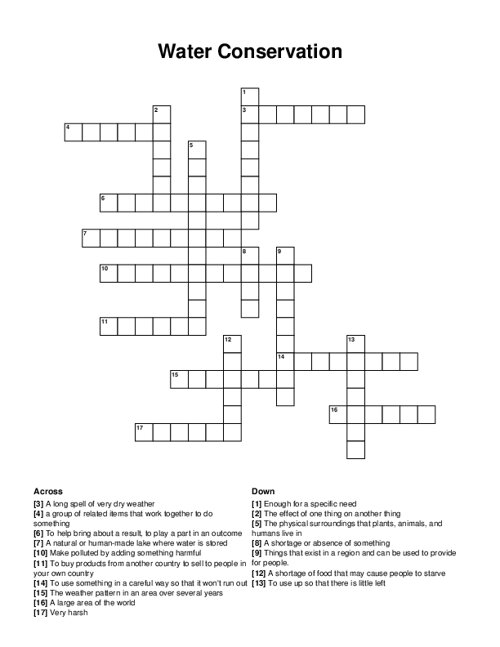
Water Conservation
QUESTIONS LIST:
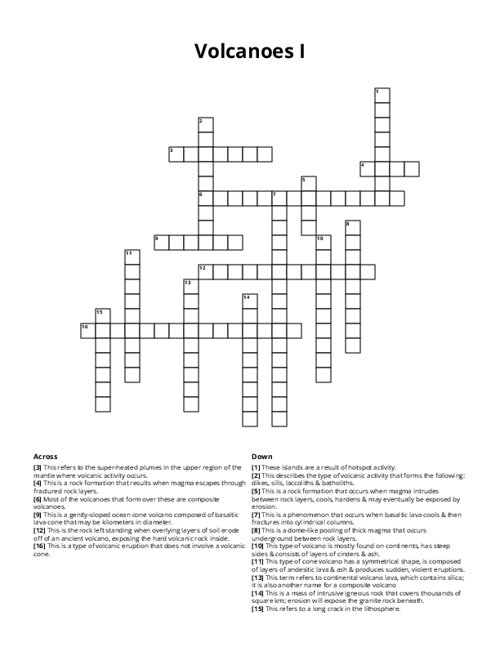
- fissure : this refers to a long crack in the lithosphere.
- fissure eruption : this is a type of volcanic eruption that does not involve a volcanic cone.
- columnar jointing : this is a phenomenon that occurs when basaltic lava cools & then fractures into cylindrical columns.
- shield : this is a gently-sloped ocean cone volcano composed of basaltic lava cone that may be kilometers in diameter.
- cinder cone : this type of volcano is mostly found on continents, has steep sides & consists of layers of cinders & ash.
- composite : this type of cone volcano has a symmetrical shape, is composed of layers of andesitic lava & ash & produces sudden, violent eruptions.
- andesitic : this term refers to continental volcano lava, which contains silica; it is also another name for a composite volcano
- subduction zone : most of the volcanoes that form over these are composite volcanoes.
- hotspot : this refers to the super-heated plumes in the upper region of the mantle where volcanic activity occurs.
- hawaiian : these islands are a result of hotspot activity.
- dike : this is a rock formation that results when magma escapes through fractured rock layers.
- sill : this is a rock formation that occurs when magma intrudes between rock layers, cools, hardens & may eventually be exposed by erosion.
- laccolith : this is a dome-like pooling of thick magma that occurs underground between rock layers.
- volcanic neck : this is the rock left standing when overlying layers of soil erode off of an ancient volcano, exposing the hard volcanic rock inside.
- batholith : this is a mass of intrusive igneous rock that covers thousands of square km; erosion will expose the granite rock beneath.
- intrusive : this describes the type of volcanic activity that forms the following: dikes, sills, laccoliths & batholiths.
