
Statistics Vocabulary Crossword Puzzle
Download and print this "Statistics Vocabulary" crossword puzzle, or solve it online directly in your browser. For the printable version, use a pencil or pen to fill in the answers. The completed answers are included, so you can easily check your work when you're finished.
PDF will include puzzle sheet and the answer key.
Related puzzles:
More Business / Finance Crossword Puzzles
Economic Policy

Principles of Risk Management
The Industrial Revolution
Introduction to Microeconomics
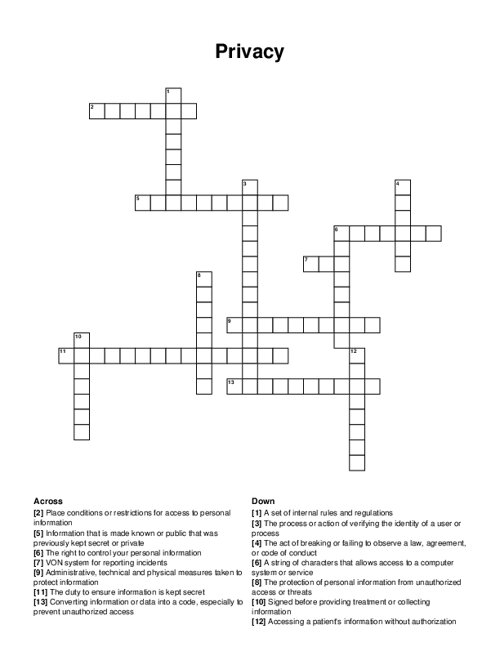
Privacy
Browse all Business / Finance Puzzles
QUESTIONS LIST:
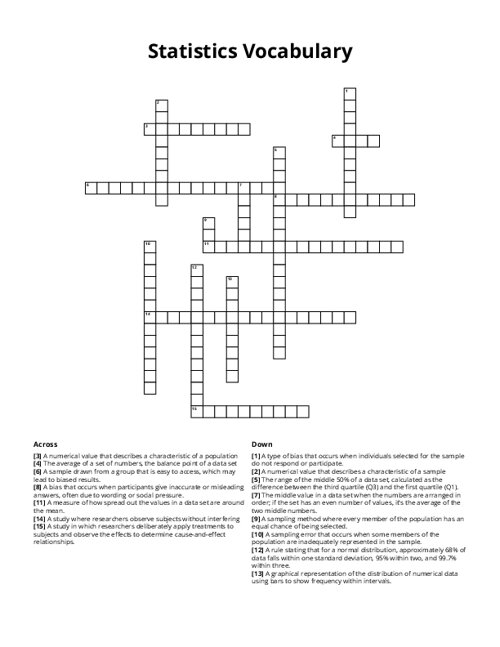
- statistic: a numerical value that describes a characteristic of a sample
- parameter: a numerical value that describes a characteristic of a population
- experiment: a study in which researchers deliberately apply treatments to subjects and observe the effects to determine cause-and-effect relationships.
- mean: the average of a set of numbers, the balance point of a data set
- median: the middle value in a data set when the numbers are arranged in order; if the set has an even number of values, it's the average of the two middle numbers.
- observational study: a study where researchers observe subjects without interfering
- srs: a sampling method where every member of the population has an equal chance of being selected.
- convenience sample: a sample drawn from a group that is easy to access, which may lead to biased results.
- undercoverage: a sampling error that occurs when some members of the population are inadequately represented in the sample.
- nonresponse: a type of bias that occurs when individuals selected for the sample do not respond or participate.
- response bias: a bias that occurs when participants give inaccurate or misleading answers, often due to wording or social pressure.
- standard deviation: a measure of how spread out the values in a data set are around the mean.
- interquartile range: the range of the middle 50% of a data set, calculated as the difference between the third quartile (q3) and the first quartile (q1).
- histogram: a graphical representation of the distribution of numerical data using bars to show frequency within intervals.
- empirical rule: a rule stating that for a normal distribution, approximately 68% of data falls within one standard deviation, 95% within two, and 99.7% within three.
