
Finance Terms Crossword Puzzle
Download and print this "Finance Terms" crossword puzzle, or solve it online directly in your browser. For the printable version, use a pencil or pen to fill in the answers. The completed answers are included, so you can easily check your work when you're finished.
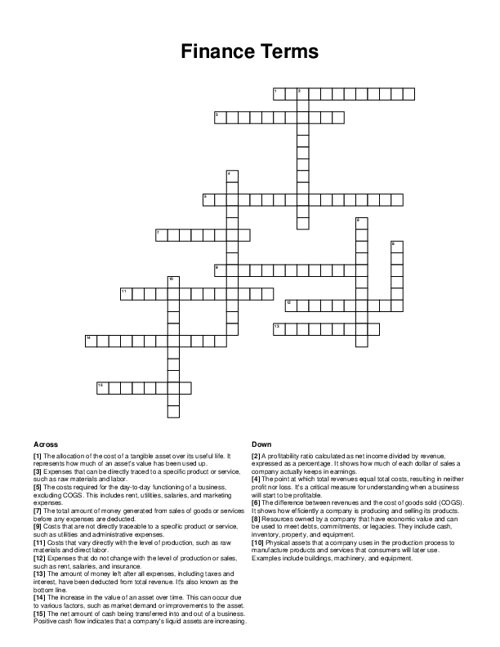
PDF will include puzzle sheet and the answer key.
Related puzzles:
More Business / Finance Crossword Puzzles
Pricing Strategy
Supply and Demand
Customer Profitability Analysis
Statistics and Data Handling
Accounting Concepts Vocabulary
Browse all Business / Finance Puzzles
QUESTIONS LIST:
- cash flow : the net amount of cash being transferred into and out of a business. positive cash flow indicates that a company's liquid assets are increasing.
- capital goods : physical assets that a company uses in the production process to manufacture products and services that consumers will later use. examples include buildings, machinery, and equipment.
- variable costs : costs that vary directly with the level of production, such as raw materials and direct labor.
- breakeven point : the point at which total revenues equal total costs, resulting in neither profit nor loss. it's a critical measure for understanding when a business will start to be profitable.
- operating expenses : the costs required for the day-to-day functioning of a business, excluding cogs. this includes rent, utilities, salaries, and marketing expenses.
- direct costs : expenses that can be directly traced to a specific product or service, such as raw materials and labor.
- fixed costs : expenses that do not change with the level of production or sales, such as rent, salaries, and insurance.
- appreciation : the increase in the value of an asset over time. this can occur due to various factors, such as market demand or improvements to the asset.
- gross profit : the difference between revenues and the cost of goods sold (cogs). it shows how efficiently a company is producing and selling its products.
- profit margin : a profitability ratio calculated as net income divided by revenue, expressed as a percentage. it shows how much of each dollar of sales a company actually keeps in earnings.
- assets : resources owned by a company that have economic value and can be used to meet debts, commitments, or legacies. they include cash, inventory, property, and equipment.
- net profit : the amount of money left after all expenses, including taxes and interest, have been deducted from total revenue. it's also known as the bottom line.
- indirect costs : costs that are not directly traceable to a specific product or service, such as utilities and administrative expenses.
- depreciation : the allocation of the cost of a tangible asset over its useful life. it represents how much of an asset's value has been used up.
- revenues : the total amount of money generated from sales of goods or services before any expenses are deducted.
