
Dew, Frost, Fog & Clouds Crossword Puzzle
Download and print this "Dew, Frost, Fog & Clouds" crossword puzzle, or solve it online directly in your browser. For the printable version, use a pencil or pen to fill in the answers. The completed answers are included, so you can easily check your work when you're finished.
PDF will include puzzle sheet and the answer key.
Related puzzles:
More Ecology / Climate Crossword Puzzles
Water Pollution
Dew, Frost, Fog & Clouds - 2
Ecology Content
Global Wind Patterns
Waste Management
Browse all Ecology / Climate Puzzles
QUESTIONS LIST:
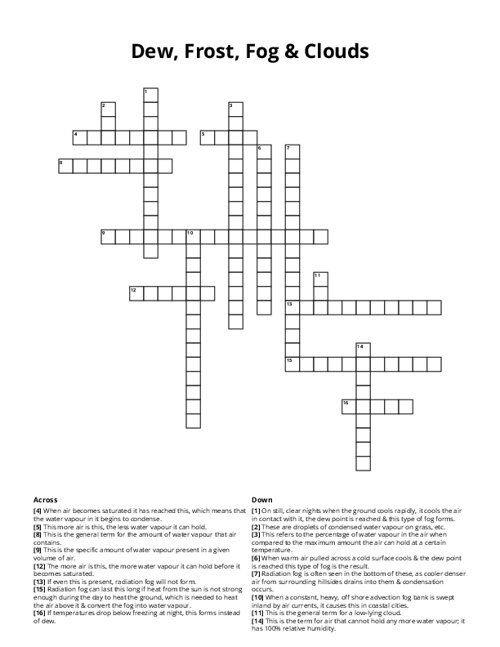
- humidity : this is the general term for the amount of water vapour that air contains.
- absolute humidity : this is the specific amount of water vapour present in a given volume of air.
- relative humidity : this refers to the percentage of water vapour in the air when compared to the maximum amount the air can hold at a certain temperature.
- saturated : this is the term for air that cannot hold any more water vapour; it has 100% relative humidity.
- dew point : when air becomes saturated it has reached this, which means that the water vapour in it begins to condense.
- dew : these are droplets of condensed water vapour on grass, etc.
- warmer : the more air is this, the more water vapour it can hold before it becomes saturated.
- cold : this more air is this, the less water vapour it can hold.
- frost : if temperatures drop below freezing at night, this forms instead of dew.
- fog : this is the general term for a low-lying cloud.
- radiation fog : on still, clear nights when the ground cools rapidly, it cools the air in contact with it, the dew point is reached & this type of fog forms.
- light breeze : if even this is present, radiation fog will not form.
- advection fog : when warm air pulled across a cold surface cools & the dew point is reached this type of fog is the result.
- travel problems : when a constant, heavy, off shore advection fog bank is swept inland by air currents, it causes this in coastal cities.
- several days : radiation fog can last this long if heat from the sun is not strong enough during the day to heat the ground, which is needed to heat the air above it & convert the fog into water vapour.
- low-lying valleys : radiation fog is often seen in the bottom of these, as cooler denser air from surrounding hillsides drains into them & condensation occurs.
