
Theater Vocab Crossword Puzzle
Download and print this "Theater Vocab" crossword puzzle, or solve it online directly in your browser. For the printable version, use a pencil or pen to fill in the answers. The completed answers are included, so you can easily check your work when you're finished.
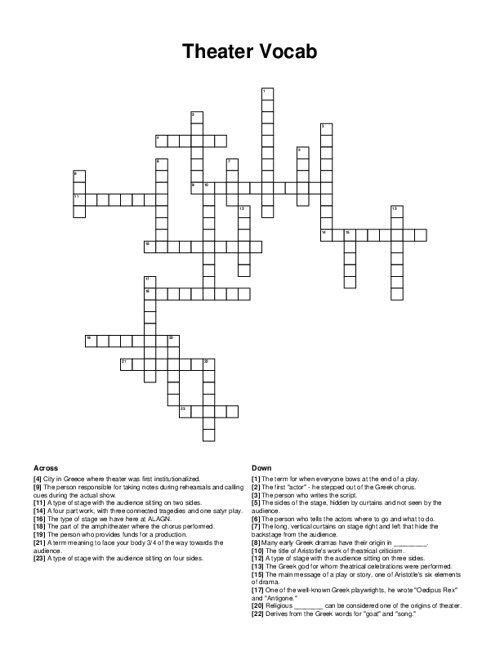
PDF will include puzzle sheet and the answer key.
Related puzzles:
More Books / Literature Crossword Puzzles
The Last Bear
Technical Writing
Descriptive Writing
Acts of the Apostle
Persuasive Devices
Browse all Books / Literature Puzzles
QUESTIONS LIST:
- wings : the sides of the stage, hidden by curtains and not seen by the audience.
- director : the person who tells the actors where to go and what to do.
- legs : the long, vertical curtains on stage right and left that hide the backstage from the audience.
- stage manager : the person responsible for taking notes during rehearsals and calling cues during the actual show.
- arena : a type of stage with the audience sitting on four sides.
- dionysus : the greek god for whom theatrical celebrations were performed.
- traverse : a type of stage with the audience sitting on two sides.
- ritual : religious _ can be considered one of the origins of theater.
- theme : the main message of a play or story, one of aristotle's six elements of drama.
- the poetics : the title of aristotle's work of theatrical criticism.
- tragedy : derives from the greek words for "goat" and "song."
- orchestra : the part of the amphitheater where the chorus performed.
- athens : city in greece where theater was first institutionalized.
- playwright : the person who writes the script.
- thespis : the first "actor" - he stepped out of the greek chorus.
- cheat out : a term meaning to face your body 3/4 of the way towards the audience.
- sophocles : one of the well-known greek playwrights, he wrote "oedipus rex" and "antigone."
- myth : many early greek dramas have their origin in _ .
- proscenium : the type of stage we have here at alagn.
- curtain call : the term for when everyone bows at the end of a play.
- producer : the person who provides funds for a production.
- thrust : a type of stage with the audience sitting on three sides.
- tetralogy : a four part work, with three connected tragedies and one satyr play.
