
Global Winds Crossword Puzzle
Download and print this "Global Winds" crossword puzzle, or solve it online directly in your browser. For the printable version, use a pencil or pen to fill in the answers. The completed answers are included, so you can easily check your work when you're finished.
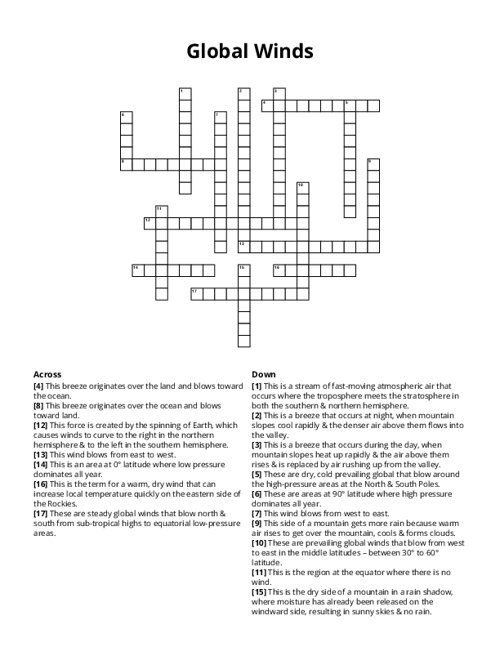
PDF will include puzzle sheet and the answer key.
Related puzzles:
More Geography Crossword Puzzles

United States Landmarks
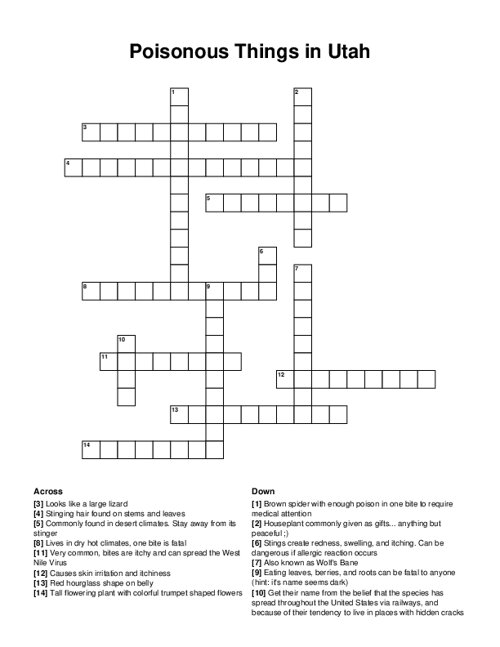
Poisonous Things in Utah

Geographical Concepts

Ocean Currents

Glaciers I
QUESTIONS LIST:
- windward : this side of a mountain gets more rain because warm air rises to get over the mountain, cools & forms clouds.
- sea breeze : this breeze originates over the ocean and blows toward land.
- land breeze : this breeze originates over the land and blows toward the ocean.
- easterlies : these are dry, cold prevailing global that blow around the high-pressure areas at the north & south poles.
- westerlies : these are prevailing global winds that blow from west to east in the middle latitudes – between 30° to 60° latitude.
- leeward : this is the dry side of a mountain in a rain shadow, where moisture has already been released on the windward side, resulting in sunny skies & no rain.
- doldrums : this is the region at the equator where there is no wind.
- coriolis effect : this force is created by the spinning of earth, which causes winds to curve to the right in the northern hemisphere & to the left in the southern hemisphere.
- westerly wind : this wind blows from west to east.
- mountain breeze : this is a breeze that occurs at night, when mountain slopes cool rapidly & the denser air above them flows into the valley.
- easterly wind : this wind blows from east to west.
- poles : these are areas at 90° latitude where high pressure dominates all year.
- trade winds : these are steady global winds that blow north & south from sub-tropical highs to equatorial low-pressure areas.
- jet stream : this is a stream of fast-moving atmospheric air that occurs where the troposphere meets the stratosphere in both the southern & northern hemisphere.
- valley breeze : this is a breeze that occurs during the day, when mountain slopes heat up rapidly & the air above them rises & is replaced by air rushing up from the valley.
- chinook : this is the term for a warm, dry wind that can increase local temperature quickly on the eastern side of the rockies.
- equator : this is an area at 0° latitude where low pressure dominates all year.
