
Earth Structure & Continental Drift Ii Crossword Puzzle
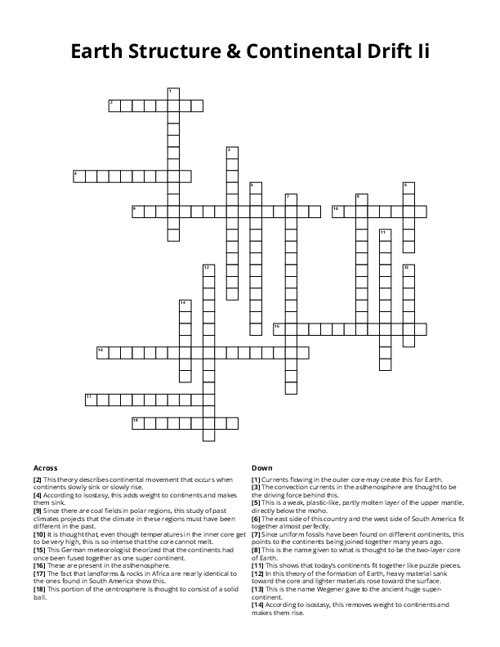
Download and print this "Earth Structure & Continental Drift Ii" crossword puzzle, or solve it online directly in your browser. For the printable version, use a pencil or pen to fill in the answers. The completed answers are included, so you can easily check your work when you're finished.
PDF will include puzzle sheet and the answer key.
Related puzzles:
More Geography Crossword Puzzles
National Parks
Regions of Alaska
Mesopotamia Review
Earth's Atmosphere and Resources
Groundwater I
QUESTIONS LIST:
- asthenosphere : this is a weak, plastic-like, partly molten layer of the upper mantle, directly below the moho.
- convection currents : these are present in the asthenosphere.
- plate movement : the convection currents in the asthenosphere are thought to be the driving force behind this.
- centrosphere : this is the name given to what is thought to be the two-layer core of earth.
- magnetic field : currents flowing in the outer core may create this for earth.
- inner core : this portion of the centrosphere is thought to consist of a solid ball.
- pressure : it is thought that, even though temperatures in the inner core get to be very high, this is so intense that the core cannot melt.
- differentiation : in this theory of the formation of earth, heavy material sank toward the core and lighter materials rose toward the surface.
- isostasy : this theory describes continental movement that occurs when continents slowly sink or slowly rise.
- glacial ice : according to isostasy, this adds weight to continents and makes them sink.
- erosion : according to isostasy, this removes weight to continents and makes them rise.
- alfred wegener : this german meteorologist theorized that the continents had once been fused together as one super continent.
- pangaea : this is the name wegener gave to the ancient huge super-continent.
- coastline fit : this shows that today’s continents fit together like puzzle pieces.
- africa : the east side of this country and the west side of south america fit together almost perfectly.
- geologic fit : the fact that landforms & rocks in africa are nearly identical to the ones found in south america show this.
- paleoclimatology : since there are coal fields in polar regions, this study of past climates projects that the climate in these regions must have been different in the past.
- fossil correlation : since uniform fossils have been found on different continents, this points to the continents being joined together many years ago.
