
Cyber Security Introduction Crossword Puzzle
Download and print this "Cyber Security Introduction" crossword puzzle, or solve it online directly in your browser. For the printable version, use a pencil or pen to fill in the answers. The completed answers are included, so you can easily check your work when you're finished.
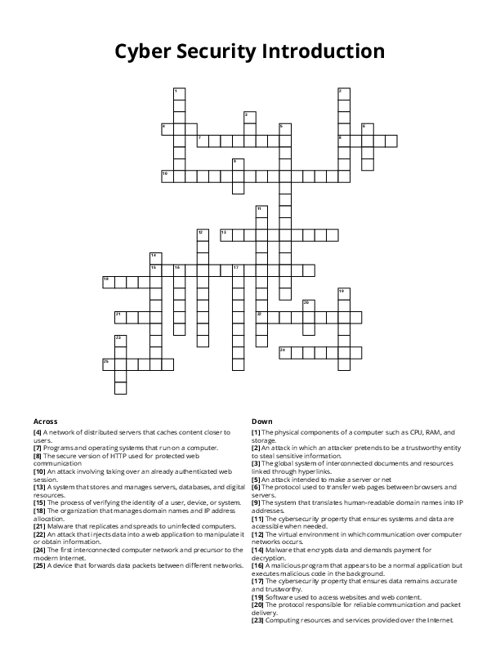
PDF will include puzzle sheet and the answer key.
Related puzzles:
More Computers / IT Crossword Puzzles
Electronic Communication
Identity Management
Types of Cyber Attacks
Classroom Applications of Technology
Database
Browse all Computers / IT Puzzles
QUESTIONS LIST:
- cyberspace : the virtual environment in which communication over computer networks occurs.
- hardware : the physical components of a computer such as cpu, ram, and storage.
- browser : software used to access websites and web content.
- http : the protocol used to transfer web pages between browsers and servers.
- dns : the system that translates human-readable domain names into ip addresses.
- arpanet : the first interconnected computer network and precursor to the modern internet.
- router : a device that forwards data packets between different networks.
- cloud : computing resources and services provided over the internet.
- icann : the organization that manages domain names and ip address allocation.
- cdn : a network of distributed servers that caches content closer to users.
- authentication : the process of verifying the identity of a user, device, or system.
- injection : an attack that injects data into a web application to manipulate it or obtain information.
- session hijacking : an attack involving taking over an already authenticated web session.
- ransomware : malware that encrypts data and demands payment for decryption.
- software : programs and operating systems that run on a computer.
- www : the global system of interconnected documents and resources linked through hyperlinks.
- https : the secure version of http used for protected web communication
- tcp : the protocol responsible for reliable communication and packet delivery.
- data center : a system that stores and manages servers, databases, and digital resources.
- integrity : the cybersecurity property that ensures data remains accurate and trustworthy.
- availability : the cybersecurity property that ensures systems and data are accessible when needed.
- phishing : an attack in which an attacker pretends to be a trustworthy entity to steal sensitive information.
- worm : malware that replicates and spreads to uninfected computers.
- trojan : a malicious program that appears to be a normal application but executes malicious code in the background.
- denial of service : an attack intended to make a server or net
